
EVENTS
Scaling Trusted, High-Impact AI Care Navigation
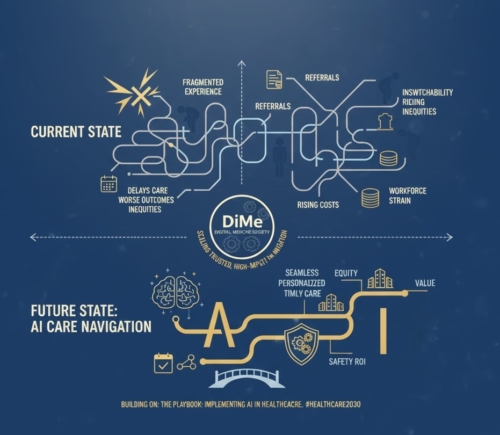
Navigating healthcare has become an exhausting and fragmented experience for many patients. Securing appointments, obtaining referrals, moving between providers, and managing insurance often require substantial effort from patients and families. These barriers delay care, worsen outcomes, and deepen inequities. The same fragmentation creates inefficiencies for health systems and payers, contributing to avoidable readmissions, lower patient satisfaction, rising costs, and strain on an already limited workforce.
At the same time, recent advances in artificial intelligence create new opportunities to support patients as they move through healthcare systems — offering the potential for more seamless, personalized, and timely navigation of care. Yet widespread adoption has been slowed by uneven quality, unclear benefit–risk tradeoffs, and a lack of shared, real-world evidence demonstrating trustworthiness, equity, and value.
To address this gap, the Digital Medicine Society (DiMe) has launched Scaling Trusted, High-Impact AI Care Navigation, a multi-stakeholder initiative focused on defining how AI-enabled care navigation can be responsibly designed, evaluated, and scaled.
This effort brings together leaders from healthcare delivery, technology, payers, patient advocacy, and policy to move beyond isolated experimentation toward shared frameworks and an evidence base grounded in real-world implementation. The initiative seeks to establish common expectations for trust, safety, equity, and return on investment, ensuring that AI-enabled navigation improves patient care journeys while delivering measurable system-level value.
A significant step in advancing DiMe’s Healthcare 2030 vision for a sustainable digital health ecosystem, this initiative builds directly on The Playbook: Implementing AI in Healthcare, developed with Google for Health and more than 30 partners to help organizations identify high-value AI use cases and move responsibly from pilots to scale. Focusing on one of the most immediate and consequential applications of AI in healthcare — how patients find, access, and move through care — the initiative aims to support adoption that is both innovative and accountable.
More information about the initiative is available at:

- Presents by: IFH & Digital Medicine Society (DiMe)
- Location:
Online | Global Initiative
- Date: January 9, 2026
- Time: 8:00 a.m. ET , 5:00 a.m PT